The Old Market-Day Story That Needs a Second Look
Learn how to trace a northern market-day custom through local records, changing routines and oral memory, and describe its history without overstating the evidence.
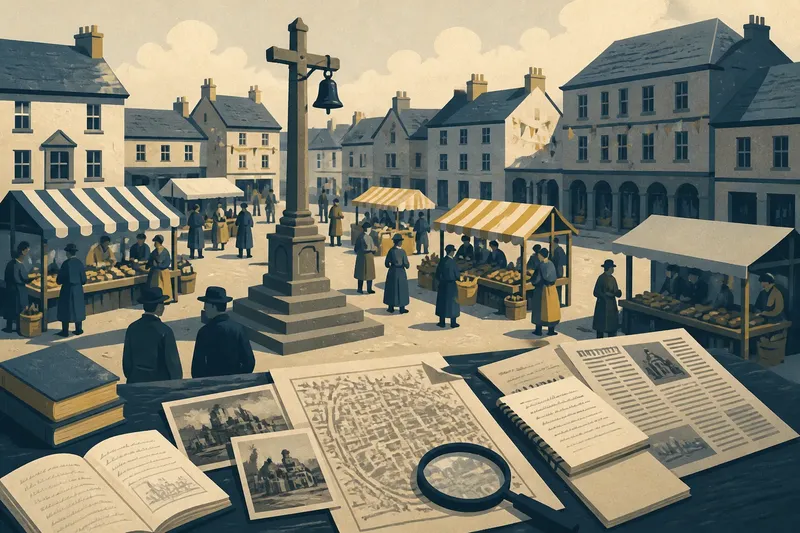
On a market morning, someone points to the town cross and says the bell has always rung there to open trade. To trace an old market-day custom, separate the remembered scene from the claims about its origin, timing and continuity. Each part may have a different history.
Describe what people did before explaining why
Start with the observable practice. Did sellers gather regularly? Was a bell rung, a rule announced or a procession made? Then set aside the explanation attached to it. A repeated action and the story told about its beginning are related, but they are not the same claim.
For instance, a bell may have signalled that trading could begin. A later account might connect it to a dramatic event. The first claim concerns a routine; the second concerns an origin. Records that support one do not automatically support the other.
Break a market-day story into separate points: the market met on a particular day; a bell marked its opening; a named event prompted the bell; the practice continued without interruption. This gives each point a clear question to investigate.
Read local records for what they were made to record
Borough and parish records, market regulations, newspaper notices, maps, directories, photographs and diaries can all help. Their purpose matters. Council minutes may record permission or a dispute, while a newspaper notice may describe one occasion. Neither necessarily captures ordinary practice across time.
Note the date of a document separately from the period it describes. A local history written later can show how a custom was remembered when the book appeared. It may also point to earlier sources, but it should not be treated as a contemporary account of events it recounts.
Search for variations in names and spelling. A market could be indexed under a street, parish, cross or nearby landmark. When a record mentions a market, it establishes that the writer referred to one at that time; by itself, it does not establish an unbroken tradition.
Trace how the routine changed over time
Words such as “always” and “unchanged” can hide adjustments. The market may have remained in town while moving between streets. Its schedule, goods, sellers or rules may have shifted, even as the gathering kept its familiar name.
Compare regulations, street plans and notices for signs of change. A new covered market, a revised opening time or a restriction on certain goods can reveal how people adapted the routine. A ceremony may also keep its name while its route, participants or place in the day changes.
Say a town’s oral account places the market bell at dawn. Imagine a newspaper notice from one period advertising trade later in the morning, and a council record from another referring to the bell without naming an hour. The result is a narrower account: the bell marked an opening, but the exact timing is unsettled. “At dawn” may describe one remembered period rather than every market day.
Use the market square as context, not proof
Crosses, churchyards, street corners and open spaces shaped where people gathered and traded. A market cross might mark civic authority, serve as a meeting point or commemorate a later event. Its location can help explain why a story attached itself to that spot, but it cannot date the custom on its own.
Compare old maps and photographs with the present layout. Look for moved entrances, altered streets and buildings that changed how people reached the market. A place name may preserve a trace of trade after activity has moved elsewhere.
It is not worth forcing every feature of a square into a symbolic story. An accessible open space may have suited traders for practical reasons. Begin with what the layout made possible, then look for evidence before assigning a more specific meaning.
Follow how people learned and retold the custom
Oral memories can preserve details that official records seldom include: who arrived early, where sellers stood or how a seasonal gathering felt. Ask who passed a story on and in what setting. A relative’s recollection, a school lesson, a booklet and a civic celebration each carry the account through a different route.
When memories conflict, work out what each speaker may have witnessed or heard. One person might recall a bell before trading; another might remember it as a signal to close stalls. Those accounts could describe different periods or uses. Their contrast can help map how the routine changed, rather than requiring a choice between them.
Compare older accounts with later revivals
A procession recreated for a festival or civic anniversary may draw on older practice while adding a route, costume or speech for a present-day audience. A revival can matter to local life without being an exact copy of an earlier event.
Set a newspaper account, local-history booklet, museum caption and current event programme alongside one another. Mark when distinctive details first appear and whether later tellings identify a source. A detail repeated in several places may have travelled from one account to the next rather than gained independent support.
Choose wording that fits what the records show. “A market is mentioned in records from this period” makes a narrower claim than “the market has always been held here.” If the origin is uncertain, say what is documented, what is remembered and what remains unresolved.
Which questions help clarify a market-day custom?
Does a regular market mean every detail stayed the same?
No. The gathering can persist while its location, schedule, rules and participants change. Evidence that a market continued does not establish that every associated custom remained fixed.
Can a later account still help explain the past?
Yes. It can show how people understood or remembered a custom when the account was written, and it may point towards earlier documents. Its date does not by itself establish when the custom began.
What should I do when records and memories differ?
Keep each account in view and consider what it describes. An official record may focus on a rule, while a memory may capture informal practice or a different period.
How can I describe an origin that remains uncertain?
Separate documented details from remembered explanations, and name what is still unclear. You can explain why a story matters locally without presenting its origin as settled.
- Check whether a record names a market or a specific custom; if it names only the market, describe the gathering but seek a separate source for the custom.
- Check whether a document is contemporary with the event it describes; if it is later, present it as evidence of later memory and look for an earlier trace.
- Check whether dates or schedules vary across notices; if they do, describe a changing routine rather than claiming a fixed time.
- Check whether maps show the market in more than one place; if they do, explain the move instead of treating the current square as its proven origin.
- Check who passed on an oral account and when; if that route is unclear, attribute it as local memory rather than a dated eyewitness report.
- Check whether a detail appears only in a recent revival; if it does, identify it as part of the present-day form unless an older source supports it.
For an old market-day custom, the clearest account keeps routine, memory and setting in view without making them answer the same question. That distinction lets a reader see both what people carried forward and what each generation reshaped.